LegalTech SaaS
Nepal IP Management System
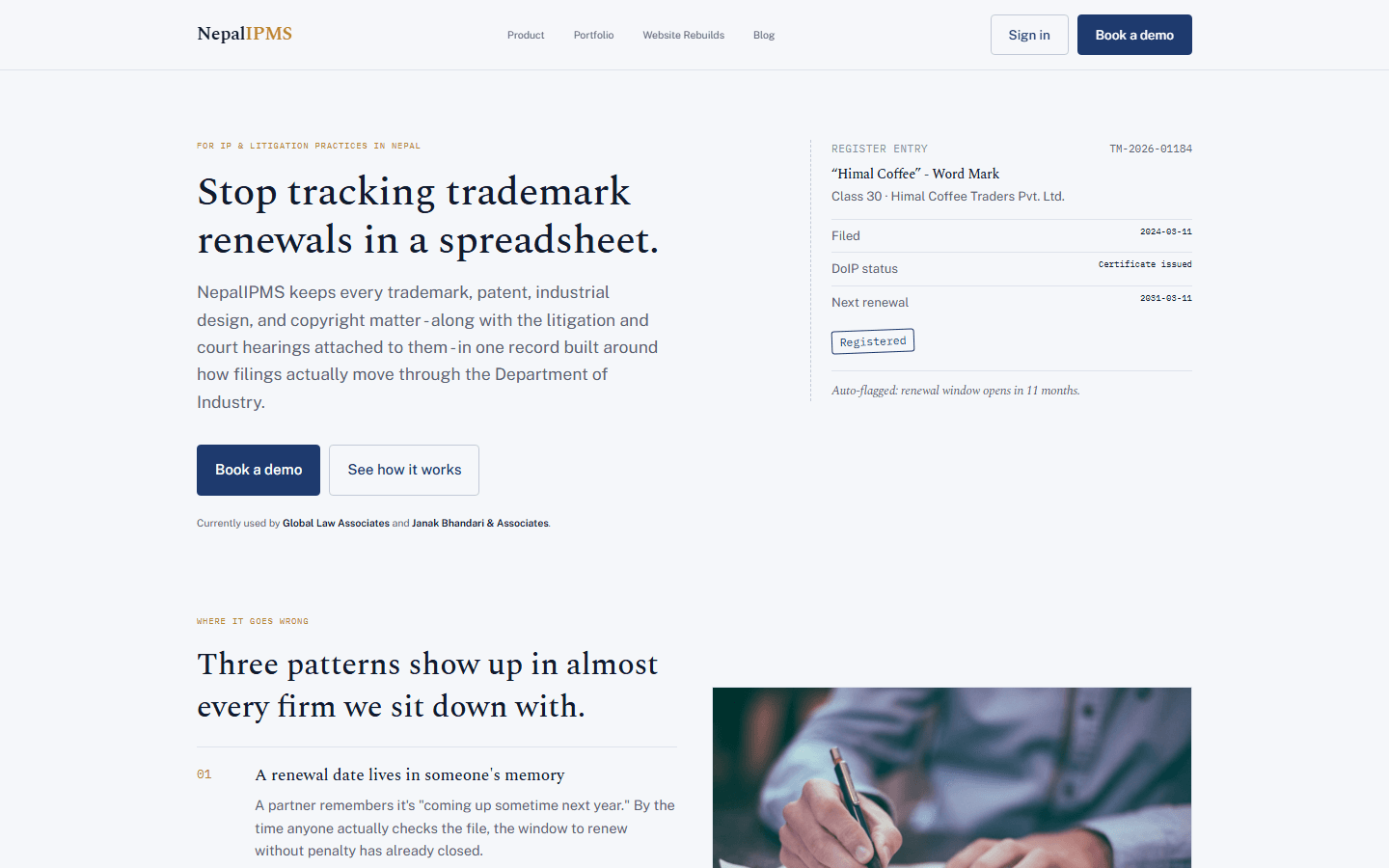
A firm opens one portal for trademarks, patents, deadlines, litigation, and national register search — replacing spreadsheets and scattered drives with matter records that mirror how IP desks already organize client portfolios.
Before
Renewal dates in personal calendars. Register lookups in shared PDFs. Bulletin entries re-typed by hand. No single view of a client’s portfolio during a live call.
After
130,000+ trademark rows searchable in milliseconds. Matter-linked deadlines with notifications. OCR-assisted bulletin intake. One system used daily by IP firms in Nepal.
1
Open a client portfolio
Navigate company → file → matter hierarchy. Every asset — trademark, patent, design — lives in context with its renewal clock and filing history.
2
Search the national register
Run a live mark or application number query against 130k+ records. Results return fast enough for phone conversations with clients.
3
Review upcoming deadlines
Renewal windows surface per matter. Staff see what needs action this week without digging through inboxes.
4
Track Department of Industry status
Application status updates link back to the matter record — so practitioners know where a filing stands before the client asks.
5
Attach documents and notes
Filings, certificates, and correspondence stay with the matter in R2-backed storage — not lost across personal drives.
nepalipms.com · Case study
Document intelligence
AI OCR Document Intelligence Engine
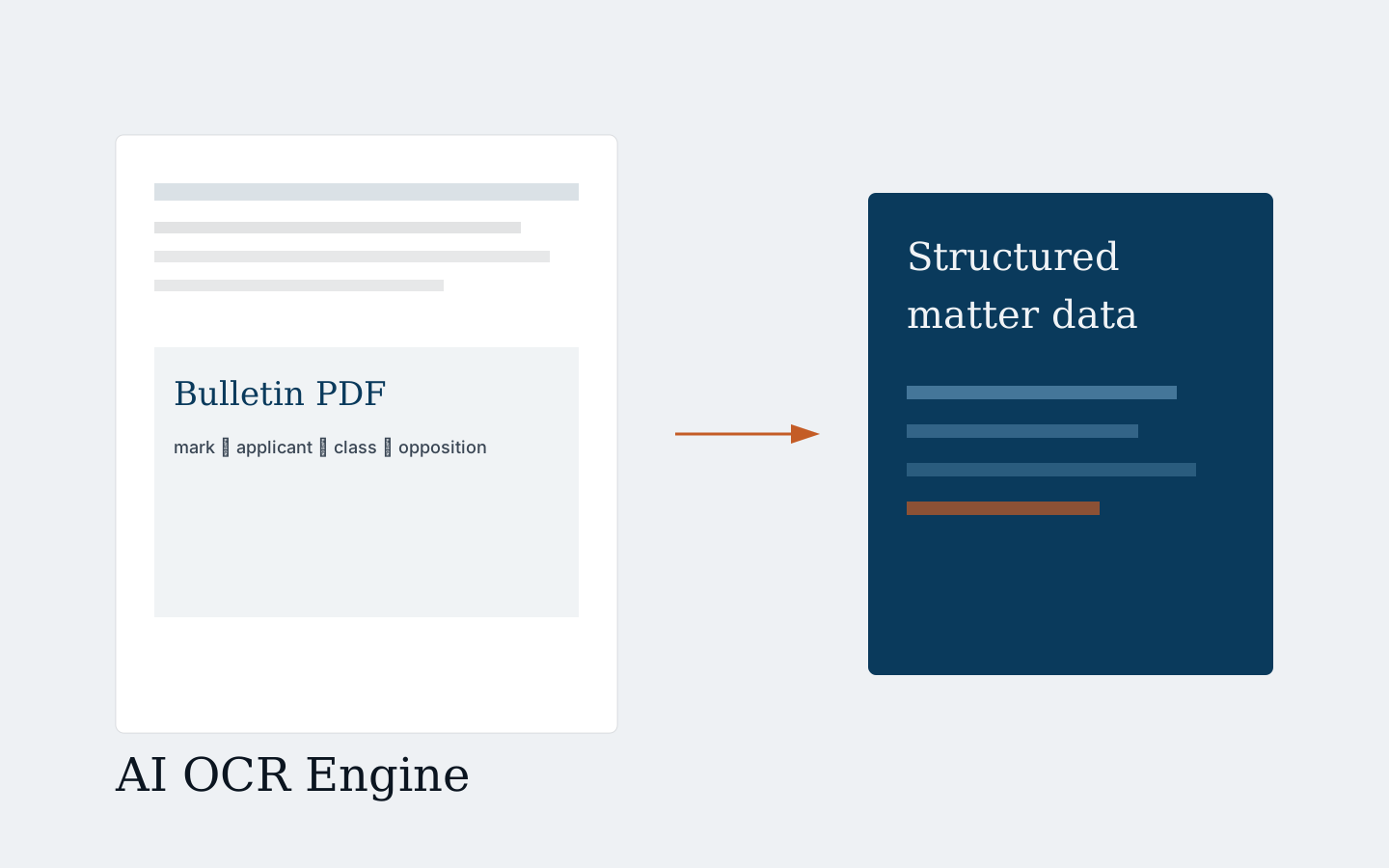
Government trademark bulletins arrive as dense PDFs. The pipeline extracts structured fields, routes low-confidence rows to human review, and merges confirmed data into live matter records inside NepalIPMS.
Before
Staff manually read bulletin pages, copy application numbers and classes into spreadsheets, and hope nothing was misread during a busy filing season.
After
Upload a bulletin PDF, OCR extracts bilingual text blocks, a worker maps fields to register schema, practitioners confirm in a review queue, and records merge automatically.
1
Upload a Department of Industry bulletin
PDF pages land in R2 with a processing job attached. The system knows which bulletin issue and date range is being ingested.
2
OCR extracts layout-aware text
Azure OCR reads Nepali and English blocks, preserving table structure where bulletins use dense tabular layouts.
3
Parse worker maps fields
Application numbers, classes, applicant names, and status lines map to the register schema with confidence scores per field.
4
Human review queue
Low-confidence extractions surface for practitioner confirmation. Experts correct errors before anything touches production matters.
5
Merge into search and reminders
Confirmed rows update the register index and link to existing matters — feeding search and renewal notifications downstream.
Case study · Engineering essay
Education · Study abroad
ScholarQuest
Students explore destinations, test preparation paths, and counselling intake in one platform — designed so counsellors receive structured leads instead of scattered form submissions.
1
Discover destinations
Browse country guides with requirements, timelines, and program types — content architecture built for comparison, not brochure scrolling.
2
Explore test preparation
IELTS, PTE, and related prep paths connect to the student’s target destination and intake season.
3
Submit a structured inquiry
Lead forms capture academic background, target intake, and budget range — fields counsellors actually need for a first conversation.
4
Counsellor-ready handoff
Inquiries arrive with enough context that staff can respond with substance, not a generic callback request.
scholarquest.com.np · Case study
Legal · Content management
Global Law Associates CMS
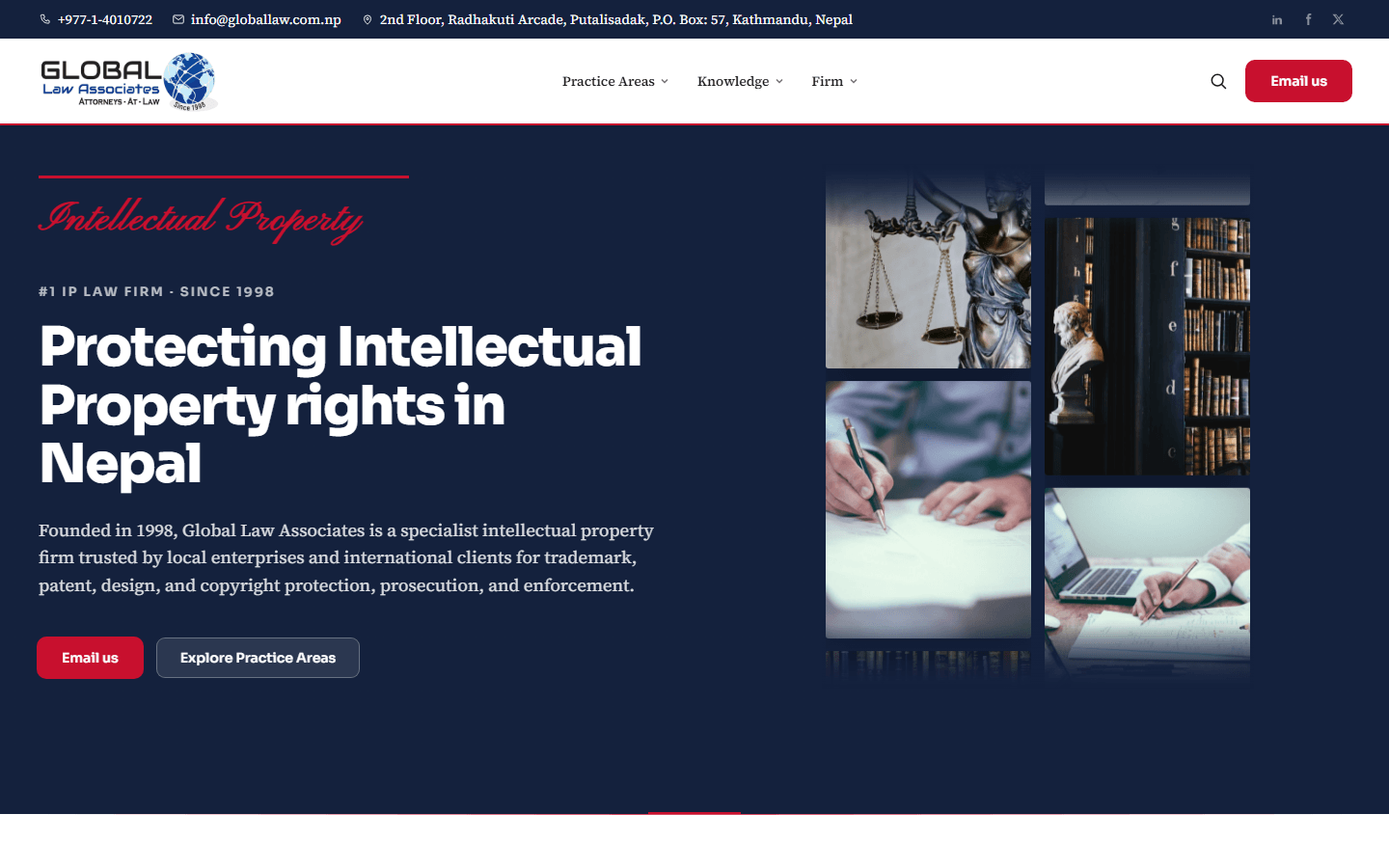
A practice website and content system for a Kathmandu law firm — service pages, team profiles, and inquiry paths that reflect how clients actually search for legal help, not generic template filler.
1
Service-oriented information architecture
Practice areas — corporate, IP, litigation — organized the way clients describe their problems, not internal firm departments.
2
Team and credibility pages
Partner and associate profiles with credentials clients evaluate before making contact.
3
Editorial content updates
Firm news and insights managed through a CMS the team can operate without developer intervention for every text change.
4
Contact and inquiry routing
Clear paths to reach the firm — aligned with the same organization that uses NepalIPMS for daily IP operations.
5
Production deployment
Fast, maintainable hosting with a design language that matches the firm’s professional positioning in Nepal’s legal market.
globallaw.com.np · Case study
Note: These walkthroughs use production UI captures and structured steps. Full screen recordings can be added as the portfolio evolves — the goal here is honest feature demonstration, not simulated video embeds.
← Back to portfolio